


Молочный улун - мифы и легенды
Nowadays, it is hard to disagree that such a variety of Chinese tea as milk oolong is one of the most popular in the world! It is on the menu of almost every restaurant. It is hard to imagine that one tea can suit the taste of absolutely everyone, even the most capricious critic. Its rich creamy-caramel aroma attracts with its novelty and, at the same time, does not scare off with excessive unusualness. To enjoy this tea, you do not need the ability to distinguish subtle flavors, which comes to a tea lover over time.
Milk oolong is very popular among girls, and is also, in general, the first tea with which people begin to get acquainted with tea culture.
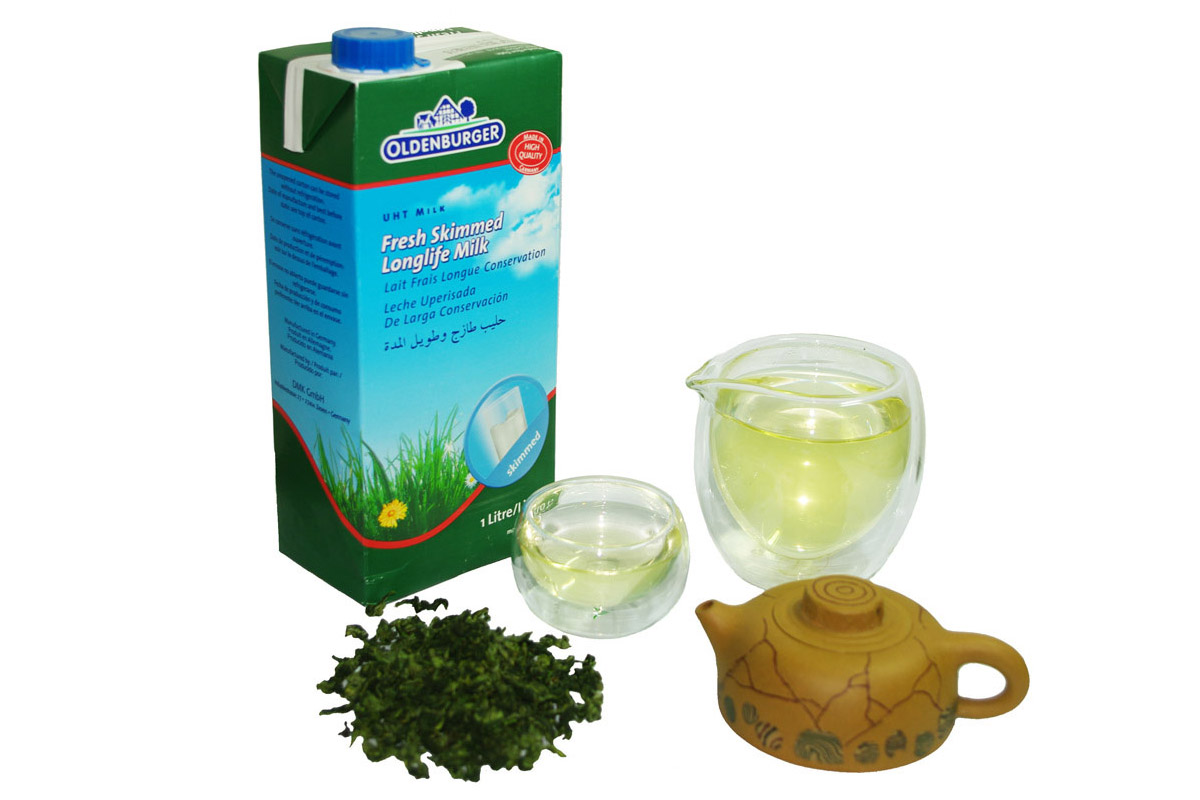
Milk oolong (milk oolong) or Nai Xiang Jin Xuan (Fiery Flower of Milky Aroma) is now so popular and sold so widely that it has long ceased to be exotic. Nevertheless, the question "What is it and how is it flavored?" asked to sellers invariably gives beautiful, but alas, baseless myths as an answer. For example:
" Milk oolong, milk oolong, milk tea" Nai Xiang Jin Xuan (milk oolong) - grown in Fu Jian province. Semi-fermented tea, located between green tea and red tea. Made from fresh leaves of Anxi tea bushes. During the drying process, tea leaves are treated with pineapple juice, which is what gives the tea a creamy taste and aroma. The color of the tea infusion is golden red..."
Or:
"Fujian Milk Oolong Nai Xiang Jin Xuan is grown in a very unusual way: the bush is pollinated with a solution of Cuban cane sugar, and the rhizomes of the bushes are watered with instant milk, and then covered with rice grain husks. The taste of the tea can be associated with the aroma of raspberry jam or condensed milk..."
Or else:
"The secret of the milky taste is in steaming the tea leaves in milk whey. The tea, under the influence of steam, absorbs all the taste and smell of milk. As a result, we have ready tea with a creamy aroma and a pronounced milky taste." Or even like this: "Milk Oolong gets its aroma from being soaked in milk."
Milk oolong (milk oolong) - history of origin.
Historically, this is how things were: Chinese tea makers are constantly experimenting with tea varieties. The Taiwanese artificially bred a variety that had a very light aroma of milk or, more precisely, caramel. The variety No. TTES-12 of tea camellia was created by breeders of the Taiwan Tea Experimental Station in 1980, primarily for the production of weakly fermented oolongs (the so-called turquoise teas) and was given the poetic name "Golden Flower" (Jin Xuan).
The best and most expensive tea is considered to be Golden Flower tea grown on Taiwanese highland plantations. Such tea can indeed have subtle, refined milky notes. But these are only notes, the intensity of which is not comparable to the thick aroma of classic Nai Xiang.
When European tea buyers tried the variety, they certainly liked it and it sold well in retail in Great Britain and Europe (there is hardly a person who does not know about the habit of the inhabitants of the British Isles to brew tea with milk at 5 o'clock). But the producers were immediately required to enhance the aroma of milk. Of course, attempts to select "milk" tea were unsuccessful, but demand creates supply, so the only way out for tea makers was the usual chemicalization and artificial aromatization. A flavoring agent called "Milk Aroma" is used, which is an alcohol solution in 20-liter canisters, manufactured in Japan and Germany. The flavoring agent is added (at the rate of about 100 grams per ton of tea leaf) after fermentation of the tea leaf before heat treatment in a drum.
It is noteworthy that in Taiwan and China they almost never drink so-called milky oolongs; all such tea is produced for export, as is any flavored tea, except for the jasmine tea (moli long zhu) beloved by Beijingers.
Of course, there are tea varieties that have caramel notes in their taste and aroma, for example, Fu Shou, many Taiwanese oolongs of this originally bred bush - Nai Xiang Jing Xuan. But this taste is not pronounced and fleeting, as it should be in a proper oolong.
Moreover, it should be noted that, in most cases, teas made from low-quality raw materials are artificially flavored to give them a “marketable” and sellable appearance and taste. This is even confirmed by the fact that milk oolong is, in most cases, cheaper than Tie Guan Yin tea, despite the fact that the same raw materials are used and additional flavors are used, which cost money.
We were faced with a difficult dilemma: to sell or not to sell the most popular tea in Russia in our online store "Tea Line". In the end, it was decided to sell tea, including milk oolong, only of high quality. Something that you are unlikely to find in other stores and are unlikely to taste in Russian cafes.