




-
10 Saturation
-
10 Aftertaste
-
10 Aroma
-
10 Effect
-
10 Balance
-
10 Body
Da Hong Pao Zhong Ho: Spring Breath of Legend
Da Hong Pao Zhong Huo is one of the most famous and revered oolong tea varieties, grown in the Wuyi Mountains of China. Harvested in the spring of 2024, this tea possesses unique qualities reflecting the unique climate and the skill of its tea masters.
This tea is a variety of oolong and is produced in the northern part of Fujian Province, in the Wuyi Mountains. Currently, tea from these original bushes is no longer produced. However, in the early 20th century, Chinese authorities permitted the propagation of seedlings from old bushes for subsequent planting. Today, over 1,000 varieties of various bushes have been cultivated in the Wuyi Mountains. The most common are raw materials from two varieties: Rou Gui and Shui Xian. The government has authorized the name Da Hong Pao for tea blends made from these different varieties. Therefore, anyone wishing to purchase Da Hong Pao can choose a ready-made blend, created by a tea technologist at the factory, or, to their liking, blend their own Da Hong Pao and then enjoy its magnificent taste and pleasant aroma.
According to legend, a Chinese man named Ding Xian, who lived in the 14th century, was walking one hot day to take an exam to obtain an important rank when he suddenly lost consciousness. He was lucky, as a nearby monastery saw him and a monk brewed him a cup of tea. The young man came to and continued on his journey. He successfully passed the exam before the emperor, and did not forget his savior. In gratitude for the favor, Ding Xian presented the monk with his red robe embroidered with a dragon. This garment was a symbol of the power he had received. When the Buddhist monk, out of modesty, refused the gift, Ding Xian covered the tea bushes with his red robe, which healed him.
Another legend tells of incredibly intelligent monkeys that lived (and still live, and they are indeed quite clever) in Wuyi Mountain. Because the little ones were so smart, locals learned to train them to pick tea growing on the hard-to-reach cliffs. To prevent the little pickers from being accidentally caught for dinner by neighbors, they dressed them in little red robes. The tea was named after the robes.
Da Hong Pao is one of the most popular Chinese teas among tea lovers. Its history is steeped in legend, and its taste leaves no one indifferent. But it is most renowned for its unique emotional impact, as brewing it relieves nervous tension and simultaneously invigorates.
Spring Harvest 2024: What Makes It Special?
Spring tea is renowned for its tenderness and smoothness. Buds and young leaves harvested at this time of year contain the maximum amount of nutrients and possess a delicate aroma. Da Hong Pao, harvested in the spring of 2024, is no exception. It is distinguished by:
- Bright color of the infusion: A golden-amber infusion with copper hues indicates the high quality of the raw materials and proper processing.
- Balanced taste: The taste of this tea is a harmonious combination of sweetness, fruity notes (peach, pear) and a slight bitterness, which gives the tea depth.
- Delicate aroma: The aroma of the dried leaf and infusion is filled with floral notes reminiscent of jasmine and orchid, as well as light honey shades.
- Gentle effect: Spring Da Hong Pao has a tonic effect without stimulating the nervous system. It promotes relaxation and focus.
Jun Ho: The Golden Mean
Zhong Ho means "medium roast." This degree of roasting preserves the tea's natural sweetness and fruitiness while adding depth and richness.

When warming the dry tea leaves with your breath, a restrained, slightly dry aroma with notes of bitter caramel is captured. After rinsing the tea, a Yixing teapot reveals a sweet and sour aroma with a hint of spice, notes of buckwheat honey, and vanilla.
The brewed tea has a slightly sweet, delicate, moderately rich, and viscous flavor. Fruity and honeyed notes are clearly noticeable. The tea's flavor remains virtually unchanged throughout the entire tea session, remaining soft and sweet. The aroma is lush and full-bodied, lingering for a long time at the bottom of empty cups. The tea holds up well; 5 grams of tea in a 150 ml teapot were steeped eight times.
The infusion is a deep, dark amber color. The aftertaste is delicate and lingering, reminiscent of a homemade sweet compote.
For brewing Da Hong Pao tea, it is best to use a teapot made of Yixing clay, which is able to best convey the taste and aroma of the tea.
This oolong tea gently warms the entire body, leaving a feeling of relaxation and lightness, while also instilling calm and tranquility. It's perfect for pleasant moments spent in good company, enjoying long conversations, or for enjoying a cup of tea alone.
|
Name in Chinese
|
大红袍 |
|
Pinyin
|
dàhóng páo |
|
English name
|
Da Hong Pao 3 |
|
Translation
|
Big red robe |
|
Tea variety
|
Da Hong Pao |
|
Country
|
China |
|
District
|
Nanping |
|
Provinces
|
Fujian (福建) |
|
Region
|
Wuyi Mountain (武夷山) |
|
Habitat
|
Уишань Баньян (武夷山半岩, wǔyíshān bànyán) |
|
A variety of tea tree (bush)
|
Jun Ho |
|
Type of tea
|
Oolong Tea |
- Reviews
- Vkontakte
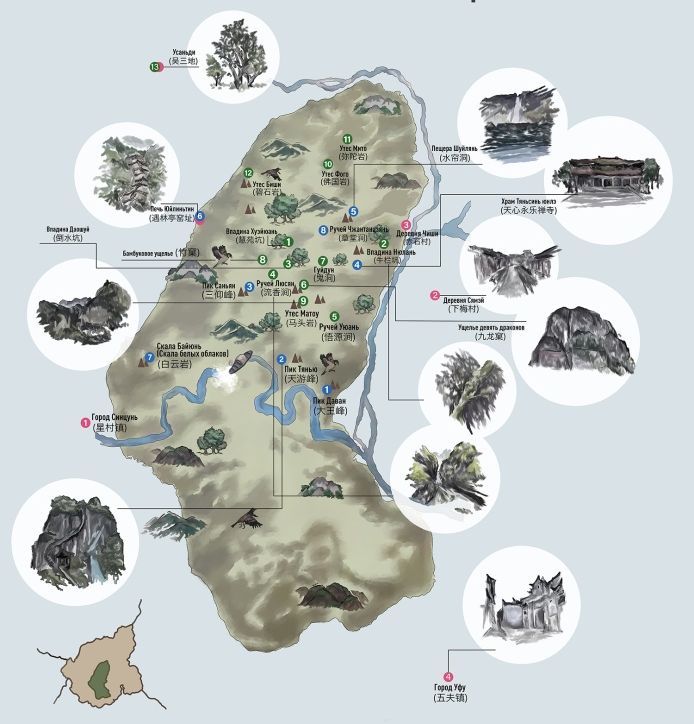

This Chinese cliff tea is produced in the northwest of Fujian Province, in the Wuyi Mountains. It is classified as a strong fermentation oolong. Da Hong Pao (大红袍, Da Hong Pao, Big Red Robe, DHP, Da Hongpao) is one of the most famous Chinese tea varieties, along with such teas as Pu'er, Tie Guan Yin and Long Jing. But in terms of the number of legends and myths surrounding both the tea itself and its name, it is probably in first place. However, this does not mean that the closest to the truth story of the origin of the name of this tea has been lost.

The Wuyi Mountains, and shan, as is known, is translated as "mountain" or "mountains", are located on the border of the provinces of Fujian and Jiangxi. This is a mountain range located on an area of about 1000 square kilometers. The highest point is Mount Huanggangshan, 2158 meters high, which is included in the UNESCO World Cultural Heritage, both for cultural and natural criteria.


