




-
10 Saturation
-
9 Aftertaste
-
9 Aroma
-
9 Effect
-
10 Balance
-
9 Body
This cliff oolong tea received its name for its rich aroma, reminiscent of brown wood. The plantations where Rougui is grown are located in the central part of the Wuyishan Nature Reserve, where the soil is rich in minerals and the steep cliffs are washed by mountain streams.
The best harvest is considered to be that harvested in spring and left to rest until autumn. The Chinese believe that processed tea needs to rest, allowing the "chi" of fire to leave the tea leaves. This results in a soft and aromatic tea.
The production process begins with air-drying, then crushing the leaves until the juices are released, which accelerates fermentation. After this, the leaves are allowed to rest and oxygenate. The process is completed by roasting in hot cauldrons and final drying over coals.
Rougui is a tea with a centuries-old history. Long before the Qing Dynasty, it was a favorite drink of Taoist and Buddhist monks. According to legend, a Taoist named Tsung Zi Po discovered a tea bush near his teacher's cave, where he meditated and subsequently transformed into another form of existence. Considering this discovery a gift from his teacher, the Taoist transplanted the tea bush to the temple grounds. Thus, Rougui came to the Buddhists and then to local farmers.
According to Chinese medicine, Zhou Gui is beneficial for the lungs and circulatory system. It has a comprehensive effect on the body, enhancing performance and increasing energy. Regular use significantly improves mood, relieves stress, normalizes blood pressure, and strengthens all of the body's defenses.

When dried, the tea's aroma is bright and rich, with hints of spices, tart herbs, and brown bread toasted in butter. After rinsing, the tea leaves acquire a vibrant and fresh aroma.
The first two steeps offer a robust, intensely fiery flavor, oily, and slightly tart, with hints of oriental spices and a subtle taste of black bread crusts at the end of the sip. By the fifth steep, the flavor becomes more subtle and soft, the strong spice notes become less pronounced, and a slight astringency emerges that quickly dissolves into the aftertaste. This tea has aged seven intense steeps. Zhou Gui leaves a bright, slightly sweet aftertaste interspersed with notes of bread crusts.
The infusion is a deep bronze-amber color, becoming lighter as you steep it more times. The infusion is clear and transparent.
For brewing this tea, it's best to use a teapot made of Yixing clay, which has special properties. This oolong tea is especially popular with men, as it has a distinctive character, a powerful flavor, and a strong stimulating effect.
Tea Qi (tea energy) is straightforward and strong. Tea effectively "focuses" a person, allows them to concentrate, invigorates, and helps them clear their minds. A person who drinks Rou Gui will no longer feel rushed or anxious, but will instead be able to organize their affairs and achieve clarity.
Connoisseurs of dark Wuyi oolongs will definitely appreciate this variety. However, avid Pu'er connoisseurs should also try it for its powerful effect and rich flavor.
|
Name in Chinese
|
肉桂 |
|
Pinyin
|
ròuguì |
|
Translation
|
Cinnamon |
|
Tea variety
|
Wu Yi Ro Gui |
|
Country
|
China |
|
District
|
Wuyi Mountains |
|
Habitat
|
Уишань Баньян (武夷山半岩, wǔyíshān bànyán) |
- Reviews
- Vkontakte
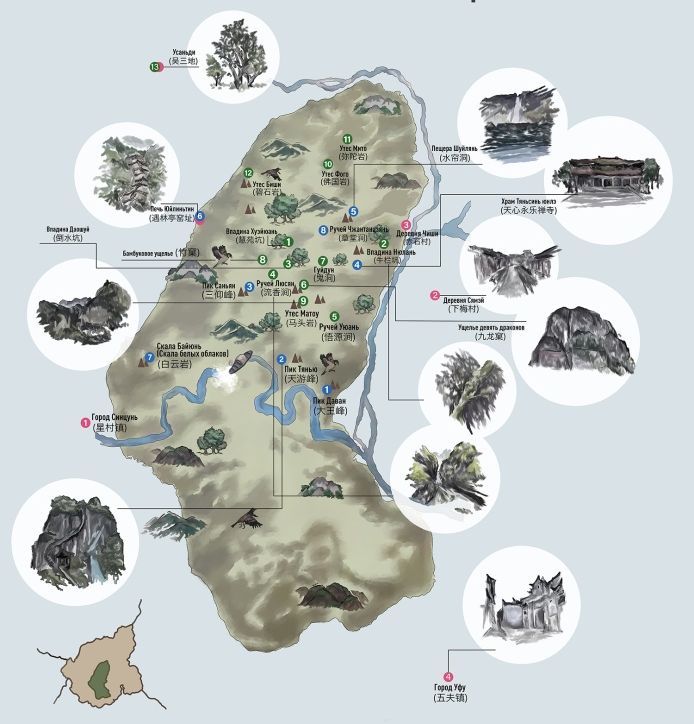

The Wuyi Mountains, and shan, as is known, is translated as "mountain" or "mountains", are located on the border of the provinces of Fujian and Jiangxi. This is a mountain range located on an area of about 1000 square kilometers. The highest point is Mount Huanggangshan, 2158 meters high, which is included in the UNESCO World Cultural Heritage, both for cultural and natural criteria.


