



-
9 Saturation
-
8 Aftertaste
-
8 Aroma
-
9 Effect
-
8 Balance
-
9 Body
The world-famous Chinese tea " Da Hong Pao," known as " Big Red Robe," grows in the northwestern part of Fujian Province. Based on its production technology and taste, it is classified as a highly fermented oolong tea. This cliff tea, grown in the Wuyi Mountains, is hand-picked and produced using traditional methods. The leaves are carefully rolled, ensuring their long, beautiful appearance.
The rolled leaves are roasted over an open fire in mesh baskets. Special ovens are also used to produce this legendary tea, ensuring the leaves dry evenly. Thanks to a production technique passed down from generation to generation, the tea retains its quality for three years. Tea production involves many stages:
- drying the leaves after collection in the air;
- careful turning of the shoots to speed up fermentation;
- roasting the leaves in a hot cauldron for several minutes;
- twisting;
- warming tea in baskets over coals.
- After the final heating, the leaves acquire a rich color and the appearance that Da Hong Pao tea consumers are accustomed to seeing.
Many interesting myths surround the origin of this popular tea's unusual name. According to one version, it was first called Red Robe in 1385. Manuscripts discovered in the Tian Xing Si Monastery explain the connection between the tea and a monk who cured a student with it. Ding Xian, the student, suffered heatstroke while on his way to an exam.
A monk from the monastery restored the boy's health and strength using only one infusion—tea. When the student successfully passed his exam, he presented his red robe to the monk who had cured him. But the healer refused the gift, as he followed Buddhist traditions. As a sign of respect and gratitude, the boy placed his robe on the tea plant that had healed him. After these events, Chinese tea from Fujian became known as Da Hong Pao, which translates as "Big Red Robe."

The aroma of dry tea leaves is spicy and rich. Bitter caramel, the crust of hot rye bread, and spices are evident. After washing, the aroma becomes more intense, revealing hints of dark chocolate and spiced dark rye bread.
The brewed tea has a rich, moderately strong flavor, with notes of bitter caramel, burnt sugar, and homemade rye bread. By the fourth steep, the tea's flavor is tempered by a firm bitterness, with hints of spice and dark chocolate predominating.
For brewing Da Hong Pao, we recommend using a Yixing clay teapot, which best brings out the tea's flavor and aroma. This Da Hong Pao teapot holds up to 7 full steeps when brewing 5 grams of tea in a 150 ml teapot.
The finished infusion is yellow-brown with a dark amber hue. The aftertaste is restrained, with moderate bitterness and notes of burnt sugar.
This oolong tea is a wonderful tonic and energizing tea, with a calming and overall relaxing effect. It can clear your head of unnecessary thoughts, set the right mood, and induce a light meditative state.
Da Hong Pao 4 Nong Xiang will appeal to lovers of dark oolongs, a strong and powerful tea with a bright taste and an equally bright state.
|
Name in Chinese
|
浓香大红袍 |
|
Pinyin
|
dàhóng páo |
|
English name
|
Da hong pao 4 Nun Xiang |
|
Translation
|
Big red robe |
|
Tea variety
|
Da Hong Pao |
|
Country
|
China |
|
District
|
Wuyi Mountains |
|
Provinces
|
Fujian (福建) |
|
Region
|
Yiwu Mountain (易武山) |
|
Habitat
|
Уишань Баньян (武夷山半岩, wǔyíshān bànyán) |
|
Type of tea
|
Oolong Tea |
- Reviews
- Vkontakte
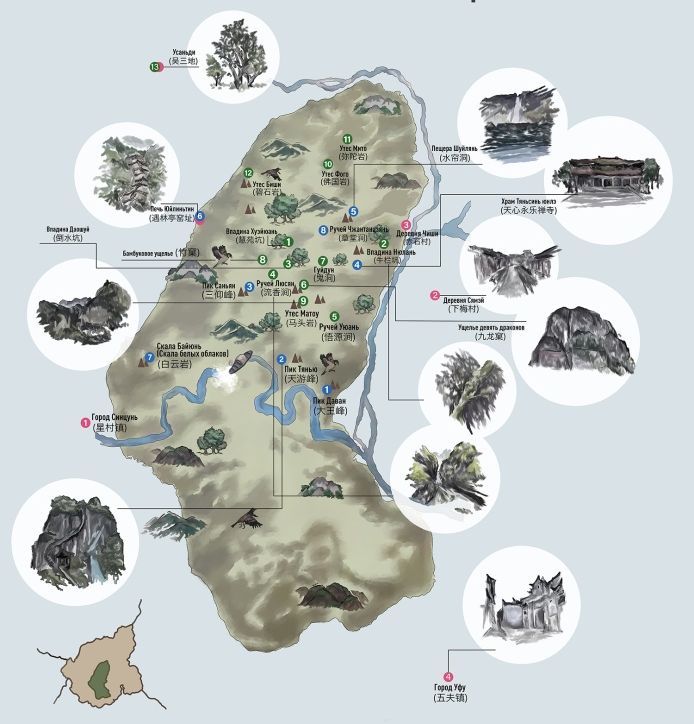

This Chinese cliff tea is produced in the northwest of Fujian Province, in the Wuyi Mountains. It is classified as a strong fermentation oolong. Da Hong Pao (大红袍, Da Hong Pao, Big Red Robe, DHP, Da Hongpao) is one of the most famous Chinese tea varieties, along with such teas as Pu'er, Tie Guan Yin and Long Jing. But in terms of the number of legends and myths surrounding both the tea itself and its name, it is probably in first place. However, this does not mean that the closest to the truth story of the origin of the name of this tea has been lost.

The Wuyi Mountains, and shan, as is known, is translated as "mountain" or "mountains", are located on the border of the provinces of Fujian and Jiangxi. This is a mountain range located on an area of about 1000 square kilometers. The highest point is Mount Huanggangshan, 2158 meters high, which is included in the UNESCO World Cultural Heritage, both for cultural and natural criteria.


